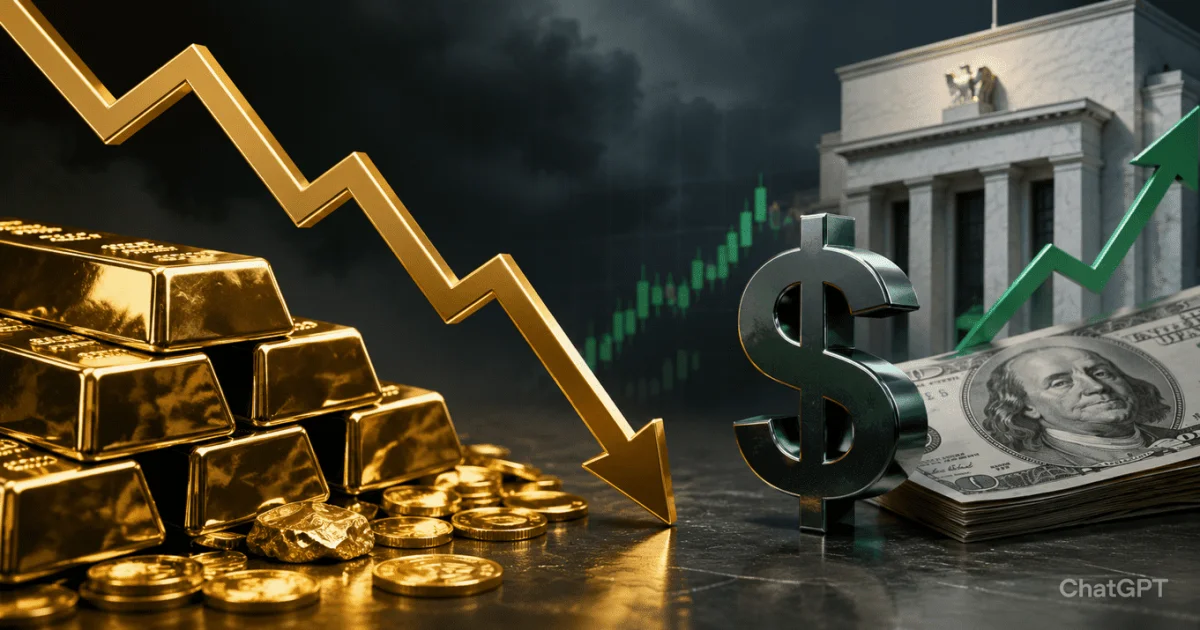
Gold dips as Strong Dollar and Fed Outlook Pressure Bullion
Gold prices moved lower on Thursday as a stronger U.S. dollar and fading expectations for Federal Reserve rate cuts reduced demand for safe-haven assets. Despite ongoing tensions in the Middle East, investors shifted focus toward resilient U.S. economic data and the high-profile meeting between U.S. President Donald Trump and Chinese President Xi Jinping.
XAU/USD slipped toward the $4,678 region during the North American session as traders continued taking profits near recent highs. The move lower came even while geopolitical tensions remain elevated, showing that markets are currently prioritizing interest rate expectations and dollar strength over traditional safe-haven flows.
One of the main reasons behind gold’s weakness was stronger-than-expected U.S. economic data. Retail sales remained solid in April, showing that American consumers are still spending despite rising gasoline prices and inflation pressures. This reinforced the view that the U.S. economy remains resilient and may not require aggressive rate cuts anytime soon.
At the same time, inflation data continued to worry markets. Both CPI and PPI readings remained elevated, moving further away from the Federal Reserve’s 2% target. This has pushed traders to reduce expectations for future easing, especially under new Fed Chair Kevin Warsh.
The stronger economic outlook helped the U.S. Dollar Index climb toward fresh two-week highs near the 100.00 mark. A stronger dollar typically weighs on gold because it makes bullion more expensive for international buyers while also increasing the appeal of yield-based assets.
The ongoing Trump-Xi summit also played a role in easing some safe-haven demand. While tensions over Taiwan remain a concern, markets welcomed signs of continued dialogue between the United States and China. Reports of potential Boeing deals and NVIDIA chip sales approvals added to the more positive risk sentiment in equities, reducing the urgency for defensive positioning in gold.
Federal Reserve officials also maintained a cautious tone on inflation. Kansas City Fed President Jeffrey Schmid warned that inflation remains the biggest risk facing the U.S. economy, while Cleveland Fed President Beth Hammack stressed the importance of data-dependent policymaking.
From a technical perspective, gold is struggling to break above the key $4,700 resistance zone. Momentum indicators are beginning to weaken, suggesting sellers may attempt to push prices toward the $4,650 support area. If that level breaks, traders could start targeting the $4,600 and potentially $4,500 regions.
On the upside, gold bulls would need to reclaim the $4,700 level to restore bullish momentum and reopen the path toward the $4,740-$4,800 resistance zone.
For now, gold remains caught between two major forces:
* Geopolitical uncertainty supporting safe-haven demand
* Strong U.S. data and dollar strength pressuring bullion prices
As long as markets continue believing the Federal Reserve will keep rates higher for longer, gold could remain under pressure despite ongoing global tensions.


0 Comments